Epilepsy is not a single seizure but a lasting tendency of the brain to produce them, and it affects around 50 million people worldwide. Where the seizures start matters: focal seizures arise from one region of cortex, generalized seizures involve both hemispheres from the outset. That distinction shapes which drug is prescribed and whether surgery is an option at all. What has changed most over the past century, though, is not the treatment but the explanation.
Where the stigma came from
For centuries, seizures were not viewed as clinical events but were instead labeled as a “sacred disease” or a sign of “demonic possession”. As medicine advanced through the 20th century, the stigma surrounding epilepsy shifted from a religious paradigm to a “scientific” one. Early medical assessments often labeled people with epilepsy as having cognitive inferiority and inheritable deficiency. Such labels were used to justify segregation and systematic exclusion from society.

Heredity chart from the early 20th century, categorizing individuals by sex, ancestry, and alleged hereditary traits. Conditions marked as inheritable include “feeble-mindedness”, “criminalistic” behavior, “insanity”, and “epilepsy”, the last of these marked with red symbols labeled “E”. These notations were used in the construction of family pedigrees. Reproduced from Davenport, C. B. et al. The Study of Human Heredity: Methods of Collecting, Charting and Analyzing Data. Eugenics Record Office, Cold Spring Harbor, NY (1911). Public domain.
Although modern science has largely dismissed the historical misconceptions, a global meta-analysis involving over 6000 participants suggests that over 35% of people living with epilepsy still experience social stigma. The prevalence of this stigma varies significantly by region, with rates reaching 40% in African subgroups compared to 28% in Asian subgroups. In countries like Kenya, epilepsy is still widely mislabeled as a curse or witchcraft rather than a treatable neurological disorder. Such cultural stigma forces patients into isolation and exposes them to abuse. They often fear discrimination, particularly in employment and social circles. Hence, there’s an urgent need for public education to reduce these cultural prejudices and help people safely access life-saving care.
Stigma keeps people from treatment. But even where it has been overcome and care is available, treatment runs into a second limit.
Why medication is not enough
Epilepsy care relies mainly on anti-seizure medications (ASMs). One of the major hurdles is that despite the development of first-, second-, and third-generational drugs, around 30% of patients are drug-resistant. For these millions of individuals, medications reduce the seizure frequency but do not halt the underlying disease process. Long-term use of these drugs can often cause fatigue, cognitive slowing, memory impairment, and reduced concentration, affecting overall quality of life. Because of this, research is shifting toward targeted biological repair rather than symptom management.
What already works
Before turning to what is new, it is worth being clear about what already exists. For focal epilepsy with an identifiable seizure onset zone, resective surgery offers something medication almost never does: a realistic prospect of seizure freedom. In a randomized trial of temporal-lobe surgery, 58% of patients were free of awareness-impairing seizures one year after the operation, compared with 8% of those who continued on medication alone. The problem is not the evidence but the referral. Patients are typically referred after some twenty years of seizures, by which point much of the disability is irreversible, and a later trial designed to randomize patients soon after two failed drug trials had to be stopped early because too few were sent for evaluation at that stage.
Where surgery is not possible, because no single focus can be identified or because it lies in eloquent cortex, the established options aim at reduction rather than freedom. Vagus nerve stimulation halves seizure frequency in roughly half of the patients who receive it, although complete seizure freedom is rare and about a quarter see no benefit at all. The ketogenic diet, in clinical use since the 1920s, was finally tested in a randomized trial in children in which 38% of those on the diet achieved more than a 50% reduction in seizures, against 6% of controls. Neither approach addresses the cause, and both demand a great deal of the patient and the family. For someone facing daily seizures, the difference is nonetheless substantial.
What is coming next
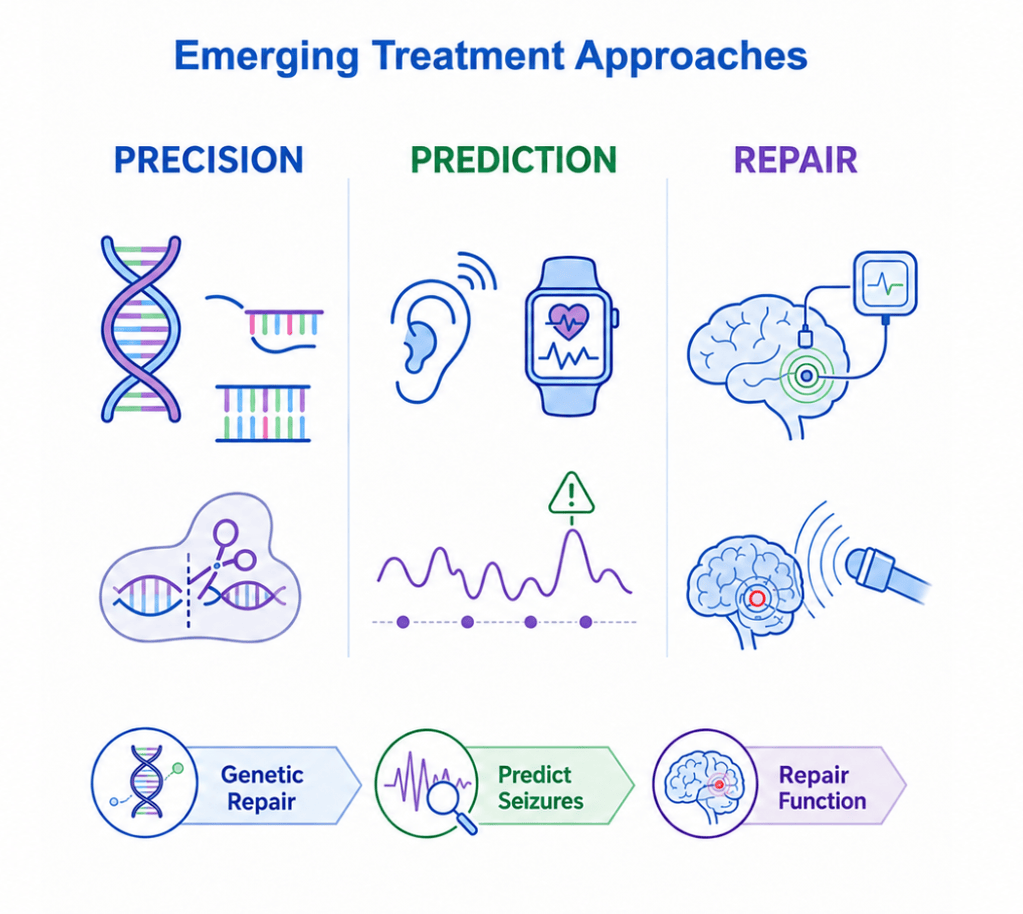
Antisense oligonucleotides (ASOs) represent tiny synthetic strands that correct the faulty RNA instructions. For instance, Zorevunersen (currently in Phase 3 trials) is designed to boost functional Nav1.1 protein to restore normal brain cell function for Dravet syndrome, which is a severe childhood epilepsy caused by SCN1A mutations. Four-year data show significant improvements in cognition, behavior, and seizure control. Beyond RNA-level fixes, genome-editing tools like CRISPR/Cas are also being explored to permanently correct such genetic variants at their source.
AI and biosensing technologies are improving seizure detection and prediction. Wearable EEG devices like discreet in-ear sensors positioned near the temporal lobe are useful for tracking focal epilepsy. Empatica’s EmbracePlus wristband can detect generalized tonic-clonic seizures by tracking skin conductance and movement. These wearables enable clinicians to build detailed seizure profiles and provide early warnings to caregivers before a seizure occurs.
The closed-loop responsive neurostimulation (RNS) has become an established option for patients with focal and multifocal epilepsy who are not eligible for surgery. This system monitors neural signals and delivers targeted electrical stimulation the moment a seizure pattern is detected. For seizures caused by localized abnormal brain tissue, such as tuberous sclerosis (TSC) or focal cortical dysplasia (FCD), clinical trials are currently validating MRI-guided focused ultrasound to destroy epileptogenic tissue without open surgery. This approach complements other precision tools, like mTOR inhibitor medications that target the underlying metabolic pathway in TSC.
Who gets access
These breakthroughs represent a shift toward treating the brain’s underlying biology rather than just its symptoms. But roughly 80% of patients live in low- and middle-income countries, where even standard anti-seizure medications are often unavailable. Progress now depends on ensuring that both existing and emerging treatments are accessible to everyone living with epilepsy, regardless of their geographic location or socioeconomic status.
Written by Mitali Katoch
Read more: A conversation called science


Leave a Reply