Science has always been a conversation. We give talks, we discuss ideas with colleagues, we read papers, and we challenge assumptions. But science is also a conversation with society. After all, many of the questions we investigate arise from the world around us, and the answers we seek are intended to improve it.
However, a PhD often doesn’t begin with a conversation, least with society. It begins with a highly specific problem (and the hunt for getting everything right, working crazy and trying to keep your sanity). Let’s assume you are a computer scientist starting in a medical lab investigating a disease. The question could be for instance, how can we diagnose a patient based on available data A, B, C? You jump right into the game. You learn data types, try to understand biological processes, you endlessly iterate over algorithms. Over time, the world narrows until every tiny detail seems important. There is a danger in this. The closer we look, the easier it becomes to lose sight of why we started looking in the first place.
This is why we encourage our early career scientists to step away from the bench or the computer and into the conversation. Writing a blog, creating a podcast, speaking to waves of a curious public at the Long Night of Science, presenting your work in a science slam or over a pint, or meeting families on events like International Epilepsy Day or congresses are sometimes described as “outreach.” The word suggests knowledge flowing in one direction, from scientist to society. In reality, the exchange is mutual.
The public learns about science. Scientists learn about purpose.
Trying to explain your work to someone outside your field is a humbling experience. Your can no longer hide behind technical terms. Complicated figures lose their importance. What remains are surprisingly simple questions. What are you trying to understand? Why does it matter? How could this make someone’s life better? If those questions are difficult to answer, you have homework.
As researchers working in epilepsy, much of our work revolves around tissue samples, imaging, genetics, or other data points. Yet epilepsy is lived neither under a microscope nor inside a computer. It is lived by people who worry about the next seizure, subsequent injuries, or how they can sleep well and safe, by children who are treated differently at school, by parents who have to deal not only with worries about the health of their kids, but strange looks that other people throw them because they do not understand the child’s behavior. In epilepsy one of the greatest challenges is sometimes not the disease itself but the misunderstanding that surrounds it.
Research becomes different once you have met the people behind the data. While the experiment does not change, the motivation does.
So today we link to a blog post that reflects exactly this journey. It was written by one of our PhD students, Mitali Katoch, who came to epilepsy research from computer science. Like many interdisciplinary scientists, she first had to learn the language of a new field. In her blog she explores epilepsy from stigma to treatment. Writing about it was more than an exercise in science communication. It is part of learning what the own research is ultimately for.
Maybe that’s the greatest value of communicating science. We don’t communicate because we know, but we communicate to understand.
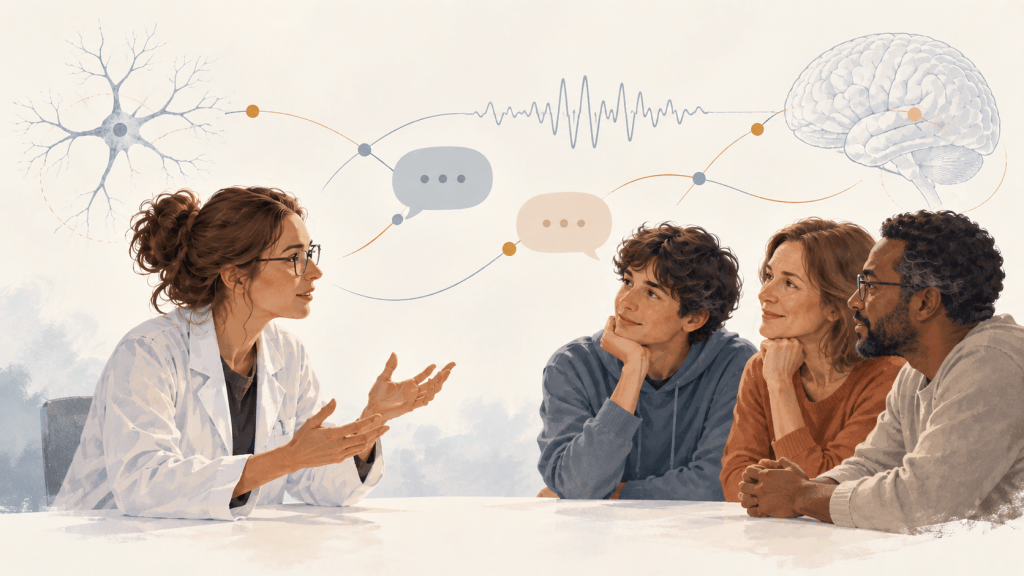
Image: generated with OpenAI, 2026.


Leave a Reply